Finally Meeting the MacGillivray's Warbler
Some birds become personal missions.
For much of this summer, the MacGillivray's Warbler (Geothlypis tolmiei) had been exactly that for me.
I'd searched several promising locations, wandered miles of trails through dense brush, listened carefully for unfamiliar songs, and come home empty-handed each time. The habitat always looked perfect. The bird simply refused to cooperate.
Sometimes, though, birding has a way of connecting seemingly unrelated adventures.
Recently, I spent a day with another local birder helping survey locations for our "Where to Bird in Kitsap County" map. We visited Big Beef Creek, Nate's Lagoon, and Mystery Point—three places with wonderful habitat and plenty of birding potential. Big Beef Creek is already well known for the incredible Bald Eagle gatherings during the salmon runs, while the lagoon and Mystery Point offered shoreline habitat that I know deserves more exploration. As usual, I completely ignored the tide tables and arrived at high tide, leaving very little shoreline to search. Such is birding.
As we walked and talked, the conversation naturally turned to county birds.
My fellow surveyor mentioned that he had managed to find many of the county’s warblers at Ueland Tree Farm.
That immediately caught my attention.
I remembered hiking to Dickerson Falls years ago, long before birding became such a significant part of my life, but I had never really explored the tree farm itself. A few days later, I met up with a friend, and we headed there with one goal in mind.
The habitat was exactly what I had hoped for—mature forest interspersed with harvested sections filled with dense shrubs and young growth. It isn't the kind of place where you'll record forty or fifty species in a morning, but it is exactly the sort of habitat where certain specialty birds thrive.
The birds didn't disappoint.
A Red Crossbill (Loxia curvirostra) gave us distant but satisfying looks, its uniquely crossed bill just visible through the binoculars. An Olive-sided Flycatcher (Contopus cooperi) called loudly from a treetop before finally offering excellent views from an exposed perch.
Then we heard it.
Neither of us recognized the song immediately, but it stood apart from everything else in the forest. We worked our way closer until we were confident enough to pull out Merlin for confirmation.
MacGillivray's Warbler.
Hearing it was exciting.
But hearing it was never the goal.
We stood quietly, scanning every opening in the brush.
Finally, the little warbler stepped into view, perched in the open for just a few seconds, and disappeared again into the thicket.
After weeks of searching, those few seconds were more than enough.
The hike continued with Cedar Waxwings (Bombycilla cedrorum), Western Tanagers (Piranga ludoviciana), Bushtits (Psaltriparus minimus), and several other familiar forest birds.
On our return trip, we heard the MacGillivray's Warbler again.
It was almost certainly the same bird, still singing from its patch of dense brush.
This time we couldn't resist.
We spent another twenty minutes patiently watching the shrubs where the song originated. Eventually, the warbler became a little more adventurous, making several brief appearances and lingering just long enough for a few photographs before melting back into the vegetation where it belongs.
Those extra few minutes transformed a satisfying sighting into one of the highlights of my summer birding.
By the time we returned to the trailhead, I realized I wasn't just excited about adding another bird to my yearly list.
I'd found another place worth returning to.
The MacGillivray's Warbler was the reason I visited Ueland Tree Farm. Next spring it will certainly be one of the reasons I return. But I'm just as excited to discover what other birds—and what other surprises—this remarkable corner of Kitsap County has been quietly waiting to reveal.
Field Notes - Ueland Tree Farm
Location: Ueland Tree Farm (Dickerson Falls area), Bremerton, Washington
Date: Summer 2026
Habitat: Mixed conifer forest, regenerating clearcuts, dense shrubland, and woodland edges
Conditions: Warm summer morning with light winds; excellent conditions for listening to singing birds
Species Highlights
MacGillivray's Warbler (Geothlypis tolmiei)
Olive-sided Flycatcher (Contopus cooperi)
Red Crossbill (Loxia curvirostra)
Cedar Waxwing (Bombycilla cedrorum)
Western Tanager (Piranga ludoviciana)
Bushtit (Psaltriparus minimus)
Notable Behavior
A territorial MacGillivray's Warbler repeatedly sang from dense shrub cover before making several brief appearances in the open, eventually allowing photographs.
Olive-sided Flycatcher persistently called from exposed treetops before dropping to lower perches.
Red Crossbill fed high in conifers, providing distant but diagnostic views of its distinctive crossed bill.
Enjoyed this field note?
Subscribe below for occasional observations and reflections from The Perch & The Path.
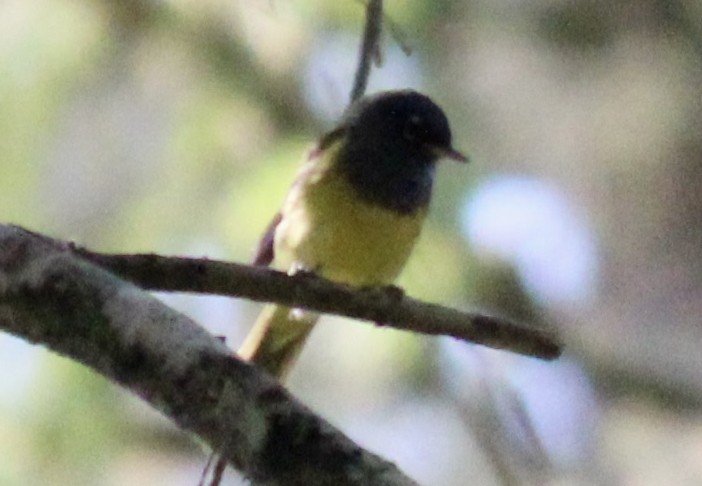
The “best” photo of the MacGillivray’s Warbler by Chris Russell
